Day One…
Today is the first day for all Saline Area Schools staff. In a couple hours we say hello to colleagues we have not seen over the summer and welcome new staff to the team. It will be a day of meetings and professional development, all filled with an anxious energy of another school year that is right around the corner. Lately I have been focused on appreciating the things we see around us everyday. Maybe it is that life is so busy these days that I feel the need to be more intentional. Maybe it’s age and with it the realization that this won’t actually last forever.
You’re lucky if you have ever truly experienced inspiration. If you are like me, even when you did you might not have recognized it. You have to make an effort to look for the beautiful things – but when you do – you see them everywhere.
Answering the Bell
It’s that time of year…. the buildings are about ready, the staff has been around getting their rooms ready for the past few weeks. It’s the time of schedule pick-up, orientations, and fall sports. Our students will be “officially” returning next week. This is time of year when educators are nervous, excited, anxious, and filled with the sense of anticipation. The 2013-2014 school year is about to begin.
Our students need us to be ready. Our students need us to be engaged. Our students need us to answer the bell.
We all have dreams. But in order to make dreams come into reality, it takes an awful lot of determination, dedication, self-discipline, and effort.
Jesse Owens
Teacher Evaluation
I can’t recall another issue that has generated as much internal conversation as the recent legislation (and subsequent adjustments by Saline Area Schools) regarding teacher evaluation. Over the past 18 months, the issue has dominated administrative meetings, professional development activities, software/management tool reviews and just about every other conversation… Based on my discussions with superintendents around the State of Michigan – we are no different than most other districts with regard to the time spent developing a “compliant” system that also meets our needs.
So, what are our needs? One of the most important things is that we want to look at what happens in the classroom and implement an evaluation system wherein the purpose is to improve the capacity of the teacher to deliver instruction that is relevant to their students. Bottomline, the system should be focused on improving instruction. We are fortunate to have an outstanding faculty in Saline – partly because our teachers understand that continuous improvement is the goal.
As we enter year two of the current teacher evaluation system it’s important for us as district leaders to understand that “continuous improvement” is our goal as well. How can we improve the process to make it more meaningful for our teachers?
Does starting early help with learning a language?
In less that a month, Saline Area Schools (with funding support from the Foundation for Saline Area Schools) will begin to teach kindergarten to 3rd grade students Spanish. We are excited about the opportunity for our community embrace learning a language at a young age. As a district, we have been providing World Language options for students from 7 through 12 grade.
A recent article in Foreign Language Annals by Beverly Boyson, Martha Semmer, and Lynn Thompson, and Marcia Rosenbusch highlights their comparison of Westport, Connecticut students who started French in kindergarten and students who had French only in grades 5-8. They looked at students’ oral and listening comprehension at the end of fifth and eighth grade, and found that students who started French in kindergarten and had it every year through middle school did significantly better, providing:
“powerful quantitative evidence to support the early-start, long-sequence K-8 program as an effective model,” say the authors.
We are hopeful that similar results will be achieved in Saline.
Summer Learning Loss
This post is for parents…
On average, American students lose about one month of learning during the summer when all the disciplines are factored together. In mathematics, students generally lose 2.6 months of learning during the summer. This means that it’s important to engage your child intellectually to help prevent/off-set the typical learning loss.
Here are some ideas for you to consider:
- Talk to them about current events.
- Ask their opinions on matters, it doesn’t need to be those difficult, open-ended questions (especially if you have a teenager).
- Take them to a museum, to the library, or to a park.
- Encourage your child to be creative. Challenge your child with a project (like a puzzle or a snow structure).
- Place boundaries on television and computer time.
- Encourage your child to read a book and then discuss it with them.
I am not saying summer needs to turn into school. You and your child(ren) need some down-time from school. I am challenging you, though, to think about the opportunities you have to enhance their learning and growth this summer.
My Summer Reading List
With summer upon us, I am looking at my summer reading options…. First, I plan to read for enjoyment this summer. One book I plan to read is Muck City by Bryan Mealer. The book was recommended to me and examines a poverty laden area in Florida that has produced a large number of professional football players.
The second book is Too Many Bosses, Too Few Leaders: The Three Essential Principles You Need to Become an Extraordinary Leader by Rajeev Peshawaria. It looks at how leaders can create focus within their organization and the conditions for success.
Another book that has been recommended for me to read is Lean In: Women, Work, and the Will to Lead by Sheryl Sandberg. The book examines why women’s progress in achieving leadership roles has stalled, 30 years after women became 50 percent of the college graduates in the United States. I wonder why it was recommended to me??
Any other books I should consider?
Saline High School – Class of 2013
This Sunday, the students in the Class of 2013 officially become “alumni” of Saline High School. They move on, with bright futures, to the next stage of their lives. On Wednesday, May 15, the members of the Class of 2013 completed transcript cards where each student indicated where they would be sending their final transcript. The results for the 464 responses are below:
Michigan Colleges (343) 74%
Out of State Colleges (83) 18%
Michigan Public Colleges (319) 69%
Michigan Private Colleges (24) 5%
All Four Year Colleges (321) 69%
All Two Year Colleges (105) 23%
Military (9) 2%
Interesting Numbers:
Michigan Private Schools:
Adrian College 1
Albion College 10
Andrews University 1
Aquinas University 1
Hillsdale College 1
Hope College 3
Lawrence Technological University 3
Northwood University 1
Olivet Nazarene University 1
Seina Heights University 2
Spring Arbor 1
Michigan Public Schools:
Central Michigan University 18
Eastern Michigan University 38
Ferris State University 8
Grand Valley State University 20
Lake Superior State University 1
Michigan State University 45
Michigan Technological University 3
Oakland University 1
Saginaw Valley State University 4
University of Michigan 56
University of Michigan Dearborn 2
Wayne State University 1
Western Michigan University 21
Michigan Community Colleges:
Macomb Community College 1
Monroe Community College 1
Oakland Community College 1
Schoolcraft College Fire Academy 1
Washtenaw Community College 103
Public Out of State Colleges:
Adirondack Community College 1
Arizona State University 1
Bluegrass Community & Technical College 1
Bowling Green State University 4
City University of New York 1
Colorado State University 1
Indiana University 2
Fashion Institute of Technology 1
Miami University (Ohio) 2
Ohio State University 3
Oregon State University 1
Owens Community College 1
Purdue University 5
The Citadel 1
Rutgers University 1
Shawnee State University 1
United States Navel Academy 1
University of Alabama 2
University of Buffalo 1
University of California – Berkeley 1
University of California – LosAngeles 1
University of Cincinnati 1
University of Florida 1
University of Illinois at Urbana-Champaign 1
University of Iowa 1
University of Louisville 2
University of Maryland-Baltimore County 1
University of Minnesota 1
University of Nebraska 1
University of North Carolina – Charlotte 1
University of Toledo 2
University of Wisconsin – Madison 1
Virginia Commonwealth University 1
Washington and Lee University 1
Private Out of State Colleges:
Belmont University 1
Berklee College of Music 2
Brigham Young University 1
Brigham Young University-Idaho 1
Case Western Reserve University 1
Cedarville University 1
Denison University 2
DePaul University 1
Dixie State College 2
Drexel University 1
Duquesne University 1
Goucher College 1
Ithaca College 1
Lewis University 1
Liberty University 1
Loyola University Chicago 2
Northwestern University 2
Norwich University 1
Ohio Dominican University 1
Otterbein University 2
Rensselaer Polytechnic Institute 1
Ringling College of Art and Design 1
Savannah College of Art and Design 1
Taylor University 2
Trine University 1
University of Evansville 1
University of Notre Dame 1
Wheaton College 1
Wittenberg University 1
Other interesting facts about the Class of 2013:
7 National Merit Semi-Finalists
7 National Merit Finalists
7 National Merit Commended Scholars
12 Students having a cumulative unweighted grade point average of 4.0 or higher
74 Students having a cumulative weighted grade point average of 4.0 or higher
107 Students having a cumulative unweighted grade point average of 3.667 – 3.999
92 Students having a cumulative weighted grade point average of 3.667 – 3.999
This week Thomas Friedman wrote an interesting editorial about the hiring process that employers and job seekers have seen in recent years. The piece called, How to Get a Job, highlighted the need to show the ability to apply knowledge effectively vs. the traditional method of showing (typically by a degree) you have knowledge.
Mr. Friedman notes,
It is best summed up by the mantra from the Harvard education expert Tony Wagner that the world doesn’t care anymore what you know; all it cares “is what you can do with what you know.” And since jobs are evolving so quickly, with so many new tools, a bachelor’s degree is no longer considered an adequate proxy by employers for your ability to do a particular job — and, therefore, be hired.
The issue highlights the need for us to provide our students with opportunities to apply knowledge and develop skills – which is a far cry from the standardized tests we are using to “assess” our students. I am thankful we are continuing to explore and push for more ways to provide our students with project based learning options.
Para-Educator for a Day
Earlier this week I had the opportunity to “sub” for a Para-Educator at Saline High School. It was part of a raffle where staff who donated to the “Kids Against Hunger” program had their names in a drawing to have me do their job for a day.
The day began with supervision duties at 7:30am, followed by swimming activities (no I did not get in the pool) for first hour, academic support for second hour, individual academic support for third & fourth hour, and supporting students in the Culinary Arts program during fifth hour. I quickly remembered there is very little down time when you are working directly with students!
The best part of the day was getting the chance to meet exceptional students who are working to learn the skills necessary to be successful as they enter adulthood. It was inspiring to see the students I was working with, many of whom had significant challenges, striving to learn and doing it with great enthusiasm.
It was also a great chance to see how the staff – teachers, para-educators, administrators and support staff all work together to support our students. I was very impressed by the professionalism, dedication and sincere interest in meeting the needs the students that was displayed in each of their classrooms.
Thank you to the students and staff for putting up with me for the day!
Thank You….. Gracias!
“In every community, there is work to be done. In every heart, there is the power to do it.” – Marianne Williamson
Last night the Foundation for Saline Area Schools presented Saline Area Schools with a check for $75,000. This investment will allow us to implement a Spanish language instruction for all kindergarten to 3rd grade students next year. I continue to be amazed by the generosity and support we receive from the Saline community.
The elementary language program is a key component of our Strategic Framework Goal #2 “All students will acquire and apply essential skills to be continuous learners and productive citizens in an ever-changing 21st Century global society.”
Thank you to the Foundation for Saline Area Schools and all of the staff and community members that helped make their goal a reality.
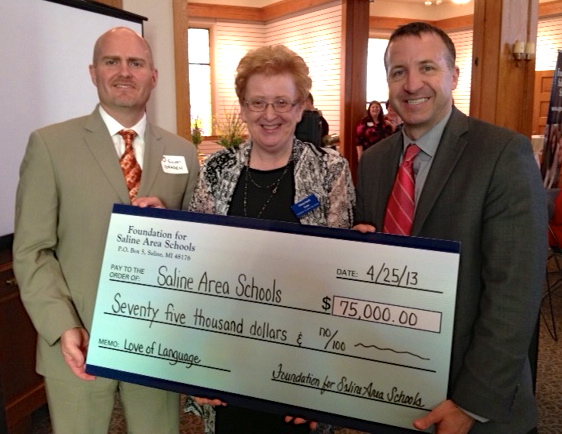
(l-r) Scot Graden, Superintendent, Cheryl Hoeft, President FSAS, Steve Laatsch, Asst. Superintendent of Instructional Services


 Scot Graden's Blog