Asking for Feedback
Last week I asked the administrative team for feedback. It was a quick 8 question survey. I had the chance to begin reading responses today. There was a lot of information that I expected, but also new information that will help me grow as a leader. One of the questions was related to steps I could take to improve communication. It was great to see that many made references to our Strategic Framework and how important it is that we continue to focus our efforts to make sure the framework is effectively implemented and communicated.
As leaders and learners – we can’t be afraid to ask for honest feedback. Author of the One Minute Manager, Ken Blanchard said,
Snow Day Notification Process

It’s that time of year…. the time of year when many of my conversations with students or staff either starts or ends with a discussion about the weather and the possibility of a snow day. I want to take this opportunity to share information about the plan this year for notifying families in the event of a snow day.
First, the place we post the cancellation first is on the @SalineSchools twitter page. We do this because it’s simple to do and if users want it will generate a text message directly to their phone. Second, we post it on the school website, the Saline Schools Facebook page, and it’s recorded as the greeting on the 429-8000 phone line. Third, it’s called into to local tv and radio media. Note: many of these are happening simultaneously.
In the past this was sometimes followed by individual schools (principals) sending automated messages to their families. The practice always generated mixed feedback from families. Some was positive – they got the call and then were able to make plans for the day. Some was not – it was sometimes too early or not early enough. Internally, we debated the merits of the “family all call” and the process of having it done at the building level.
We have made the decision that this year if (and it’s a big IF!) we have a snow day, there will be one “family all call” made from the district office at approximately 5:45am. This will prevent multiple calls for families with students at multiple buildings. It will be early enough for most families getting ready for high school or middle school. It will be very early for families with only elementary students – but will provide with ample notice if alternative arrangements need to made for child care.
If you are in a situation where you or your child are coming to school early – like swim practice, early study hall, etc. Please make sure to check the other methods of notification and don’t wait for the call. It is possible and even likely that the decision to close school will be made prior to 5:30am – and posted in the locations noted above. However, the family all call will still take place at 5:45am – not earlier.
In the end, there is not perfect solution. We hope this process works for the vast majority of families.
Fall ends.. and Winter begins…
Over the past several days our students and staff have taken and graded exams, held parent/teacher conferences and prepared for the transition to the “winter” trimester. At the high school level, our fall sports season wrapped up. It was another extremely successful campaign… this past weekend our Girls Swim & Dive team capped off the fall sports season as the MHSAA Division I State Runner-Up!

2013 Division I State Runner Up
The winter trimester starts tomorrow – with a short week. This is great chance for students and staff to spend time with their families and be thankful for the start we have had to the 2013-2014 school year. The next 12 weeks will be important as we focus on opportunities for growth and development.
Parent/Teacher Conferences
A few tips:
- Prior to the parent/teacher conference, talk to your child to know your student’s teachers, classes and their perspective of the course(s). This allows the education discussion to begin at home and fosters the family and school partnership.
- To best utilize your time, prepare your prioritized questions for discussion.
- Arrive on time or a a few minutes early.
- Take notes to allow you to review the conference with your child.
- Do not stay beyond your alloted time. Future conference opportunities can be discussed to continue important discussions.
From all sides, communication is the key to continued success and less stress. The more we can effectively communicate with each other, the greater the odds of helping the individual child maximize their entire Saline Area Schools educational experience.
Scapegoats vs. Learning from Mistakes

I read a blog post by Dan Mulhern this morning about society’s need for scapegoats and sacrificial lambs. The premise is that when things don’t go well – heads should roll… that people need to be “held accountable” in ways that mean leaving the assignment, project or the organization. Is this healthy for us as a community of learners?
We (at least in Saline Area Schools) often talk about the need to learn from mistakes and to not be afraid of failure. We understand that to be an organization that innovates, we need to take risks and be okay with it when it doesn’t always work out. Whether you are an adult or a student – we can all benefit from focusing on the learning that comes with not being afraid to make a mistake.
Do we need high levels of accountability? Absolutely! But… that doesn’t mean that we focus on the person related to the issue, it means we focus on learning from the mistake and improving.
Pleasant Ridge Pride

(l-r) Mr. Bezeau, Mr. Welton, Mr. Pratt
On Friday, I had the opportunity to visit Pleasant Ridge to watch the culmination of their PTA fundraiser. This meant that three staff members – Principal Bezeau, Physical Education Teacher Mr. Welton and Lead Custodian Mr. Pratt – would be dunked by the students!
Anyone who was there can attest to the energy in the gym as the students prepared to dunk them. It was one of those enjoyable moments where adults and students come together to have fun and celebrate the sense of community they have built. When Mr. Bezeau arrived at Pleasant Ridge two years ago after having been a Guidance Counselor and Assistant Principal at Saline High School, one of his goals was to build a strong sense of pride among the students, staff and parents. He coined the slogan, “Pleasant Ridge Pride” and had it painted in the building.

Well, after seeing the event on Friday…. there is little doubt that the Pleasant Ridge community has strong sense of pride in their school.
Click here – Welton Dunk – to watch Mr. Welton get dunked!
Better…. Not Bitter…

Growth is seldom a straight line from novice to expert. It often looks like the stock market with ups and downs along the way. With this in mind – our response those ups and downs is critical. We cannot, as learners and leaders, lose focus when our immediate efforts don’t result in success every time. In the end, our ability to remain positive and persistent is the key to continuous improvement. We must focus on getting better…. not bitter.
Organizational Culture… What is ours?
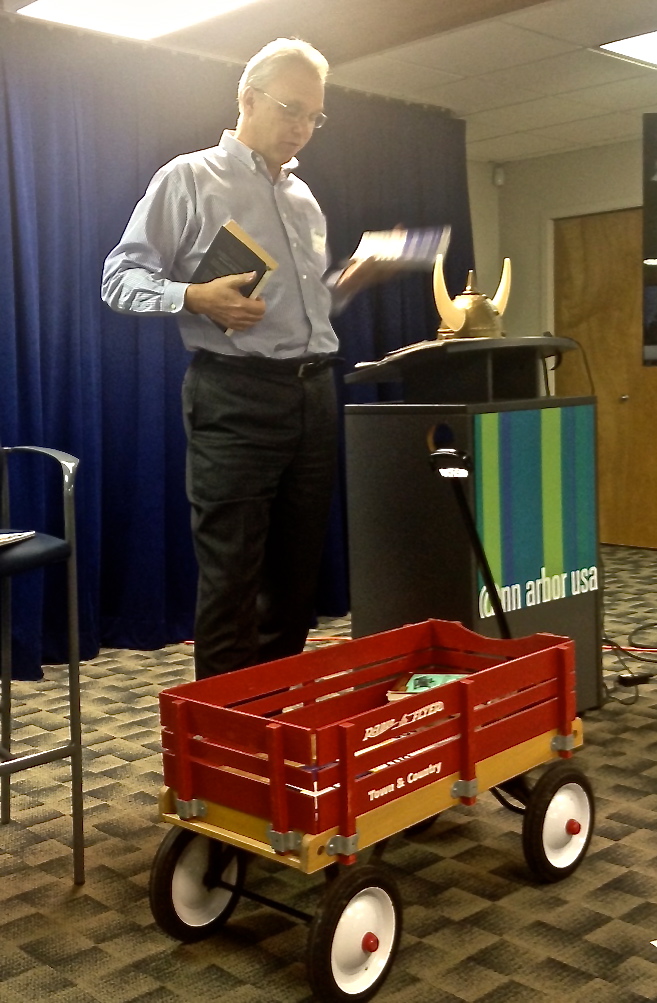
The Central Office administrative team and I had the opportunity to hear a few local leaders, including Richard Sheridan from Menlo Innovations, talk about organizational culture at a free event hosted by Ann Arbor SPARK. At the event, Rick told the group that it was important to talk explicitly about your organizations culture (and have artifacts, hence the red wagon & viking helmet above). Which begs the question for Saline Area Schools – what is our culture?
In general, an organization’s culture is defined taken-for-granted values, expectations and collective memories that define the organization’s core identity.
So – how would you describe the culture of Saline Area Schools? What do we value? What do we expect? What are the collective and shared memories that define our school district?
Can access to digital tools actually improve student writing?
 One criticism that I have heard related to the “digital age” in education has been that students aren’t writing “like they used too.” Well, according to a recent Pew Research study – the opposite is true. The study reports that 78% of the almost 2,500 AP and National Writing Project teachers surveyed said that digital tools such as the internet, social media, and cell phones “encourage student creativity and personal expression.”
The article notes:
According to teachers, students’ exposure to a broader audience for their work and more feedback from peers encourages greater student investment in what they write and in the writing process as a whole.
There is little doubt or argument that access to digital tools is changing how students express their learning. I feel there is little benefit to lamenting the shift – it’s time to embrace the change and focus on engaging the learner with rigor.
Project Management
I got an email yesterday that listed the 7 most common problems that face project managers. The number one problem (according the group that sent the email) was – “Your client gives you vague, ever-changing requirements.”
This made me think about the recent flap over the adoption of the Common Core. As educators we are expected to follow laws and guidelines established largely at the State level. For better or worse, public education is a heavily regulated industry. So, when we get vague and ever-changing requirements – not to mention conflicting messages about implementation expectations – it’s hard to manage.
What is the remedy? Well, I am not signing for the seminar the email said would explain how to deal with it – but I have a clear idea that has helped in the past. We must take control of the vision for our own school/district. If a school community, including the Board of Education, staff, students and community members, all agree on a shared vision the impact of the “vague and ever-changing requirements” is much easier to handle. The key is get everyone pointed in the same direction at the local level.
Now, doing that is a still a pretty big challenge (and will likely mean more seminars for me at some point) but it is still better than trying to ride the waves of vagueness we seem to get on a daily basis.


 Scot Graden's Blog