Student Feedback – Is K-12 ready?
There is a growing conversation about formalizing student feedback in the K-12 setting. A Saline High School student group called STRIVE (STudents Re-Investing in a Valuable Education) has been working to develop opportunities to have student voices heard regarding their own experiences in the education system. I recently reviewed an article from the Harvard Educational Review that highlights the movement on student feedback in the Boston area. The Boston Student Advisory Council asks a very good question.
“As people across the country discuss supporting and evaluating teachers, why are they not involving those with the most intimate knowledge of the classroom? As students, we are the ones in the classroom, and our futures are affected by what happens there every day.”
Over the last few years several Boston schools piloted teacher surveys that were distributed to students, with the feedback going directly to the teachers. Recently the Massachusetts Board of Elementary and Secondary Education adopted an evaluation process that includes student feedback in the teacher evaluation process for the 2013-2014 school year.
In Saline, several of our staff at the high school have used the STRIVE survey to get student feedback, others have used their own end of course student surveys for several years. Seeking feedback seems like a natural instinct, however, in a formal process, tied to teacher evaluations – it can be daunting. We are continuing to think about ways we can incorporate student voices into the process for all of us – teachers, administrators…. and the superintendent.

Difficulty is not an excuse…
Difficulty is the excuse history never accepts. ~Edward R. Murrow
Lately, I have heard a lot of excuses for a decision and almost as often the lack of a decision. As I have talked with the individuals and groups about the issue it has often boiled down to the fact the issue or decision they are wrestling with is difficult. My job has been to – in a very kind way – remind them that most things worth doing are difficult, particularly the first time you do it.
Yesterday, the Foundation for Saline Area Schools presented the District with a check for $70,000 to support our efforts around literacy. It could not have come at a better time for us, however, in some ways it could have been raised at a more difficult time for the Foundation. It would have been very easy to dismiss the $70,000 goal that was presented last August as too difficult to attain given the tough economic conditions. It could have been too difficult due the political environment, limited volunteers, other fundraising efforts, limited awareness, and any other number of excuses related to the level of difficulty. They chose to do something different, they chose to accept the challenge and by overcoming the difficulties involved – our students will benefit for a lifetime.
Making a difference is often difficult. But it reminds me of the quote from Edward R. Murrow “Difficulty is the excuse history never accepts.” Historians can look back at the Foundation and know – difficulty was not an excuse they were willing to accept.
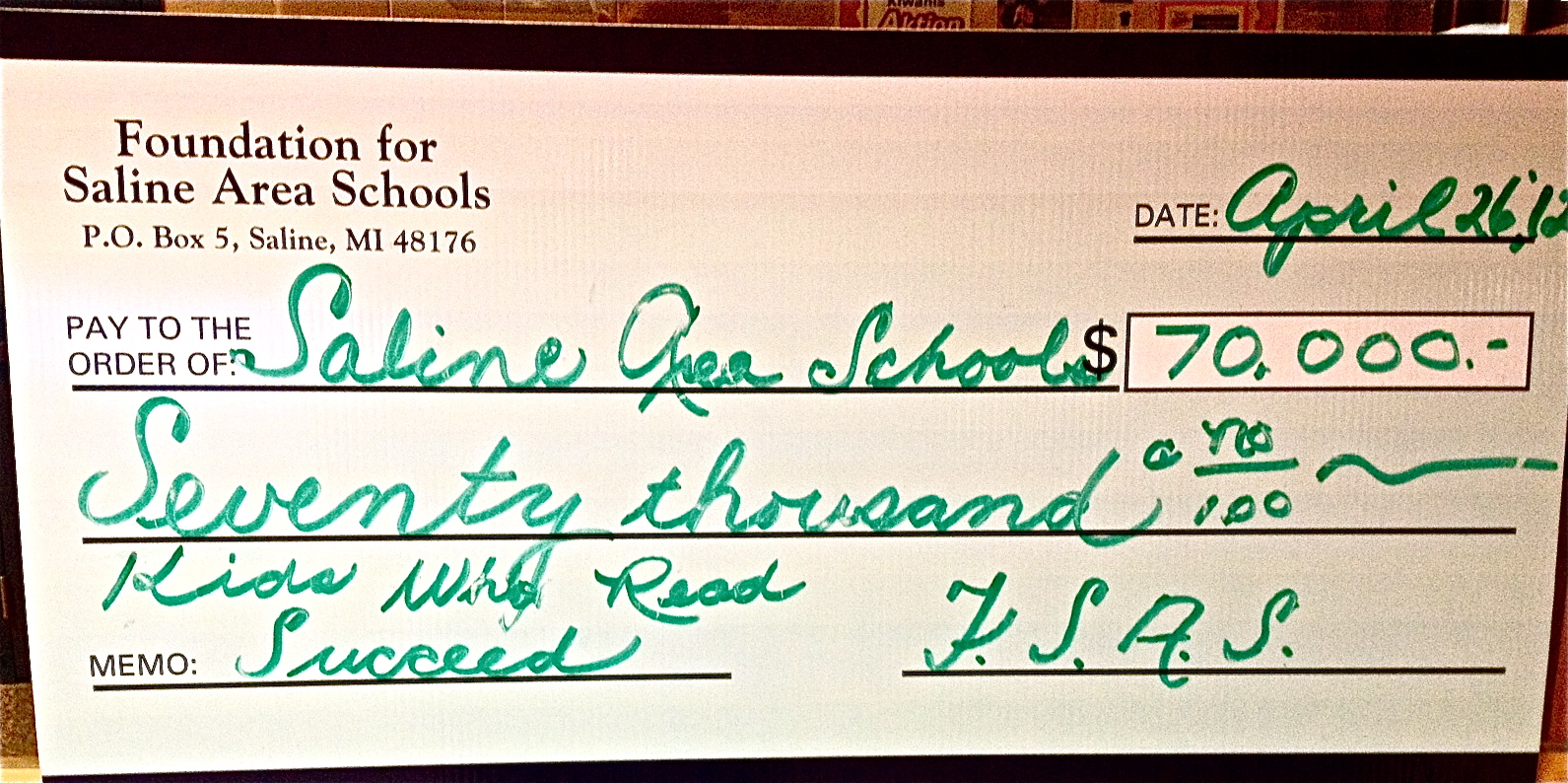
Thank you to the Foundation for Saline Area Schools and all of the staff and community members that helped make their goal a reality.
Looking for Leading Indicators
The term “leading indicators” originated as an economic theory that allowed economists to predict “lagging indicators.” For example, they learned that examining factory orders (leading) could help predict the unemployment rate (lagging) for the next month. This concept has the potential to be very useful in the field of education.
Leading indicators have three general traits:
- Timely & Actionable – It is reported in enough time to alter the course of action.
- Powerful – It provides the opportunity to track progress or lack of progress.
- Benchmarked – Levels of improvement can be determined by the users.
By monitoring certain levels of academic performance at one level, we may be able to predict future performance. Then, by focusing our efforts on these key leading indicator areas we can have a significant impact on key lagging indicators like ACT scores, high school graduation, college completion, etc. For example, we have invested time and energy in early reading proficiency as it is a leading indicator for high school completion. We are looking at clear benchmarks for reading proficiency starting in kindergarten and providing clear interventions to help students achieve them. The sense of urgency is driven not only by the desire to help the students hit the goal, but also by the impact we know it will have on the important lagging indicators years later.

Building a Data Dashboard

One of the buzzwords in education over the past year and a half has been “dashboard”. The basic idea is a location, often on a website, where community members, staff and students can see how a district is performing, much like checking the gauges on the dashboard of a car. We are in the process of establishing the “gauges” that will be part of the Saline Area Schools Dashboard. The idea is to have key measures in the areas of:
- Academic Achievement
- Grades K-8
- Elementary Percent Proficient (Math, Reading, Science)
- Middle School Percent Proficient (Math, Reading, Science)
- High School
- High School Percent Proficient (Math, Reading, Science)
- American College Test Composite Score
- Graduation Rate (Percent of the 5 Year Cohort)
- Grades K-8
- Financial Management
- Percent of Fund Balance Maintained at or above 5% Threshold
- Market Share of Saline Students (Percent of County Residents)
- Student Demographics
- Total District Enrollment
- Student Minority Percentage
- Student Percent Free/Reduced Lunch
- Staff Demographics
- Total Certified Staff (Non-Administrative)
- Total Support Staff
- Total Administrative Staff
- Percent of Teachers with Masters or Higher
- Average Number of Years of Service for Teachers
- Asset Protection
- Community Satisfaction with Buildings and Properties
- School & Community Relations
- Academic Reputation
- Parent Satisfaction with Academic Program
- Parent Satisfaction with Customer Service
These key areas are then broken down into specific data points that are measured year to year. Prior to the beginning of the next school year, the Board of Education will meet to discuss the data points, and where appropriate, establish targets for the upcoming school year.
Are there any other data points you feel we should consider for inclusion on the dashboard?
Community Conversation – Tuesday, May 1st
Saline Area School Community,
With less than two months left in the school year, I would like to schedule one more “Community Conversation” meeting for 2011-2012. Over the last four years I have had the opportunity to host several “Community Conversation” events to learn more about what interested community members see as the strengths of Saline Area Schools, and what areas they felt we needed to focus attention on for improvement. Through these conversations and other opportunities, I have learned a great deal about how many of you see our district and it has helped guide me, along with the Board of Education, as we move forward.
In an effort to continue this dialogue, I will be making time available on Tuesday, May 1st from 9:30am- 11:00am at Brewed Awakenings, 7025 East Michigan Ave. Please stop by, say hello and bring any thoughts about the district you feel I should know.
Thank you,
Scot Graden
Project Based Learning – always the best approach?
As many of you know, I often sing the praises of the Project Based Learning approach. However, a recent article in American Educator called “Putting Students on the Path to Learning: The Case for Fully Guided Instruction” looks at whether or not it is always the best approach.
According the research conducted by the authors,
“Controlled experiments almost uniformly indicate that when dealing with novel information… students should be explicitly shown what to do and how to do it, and then have an opportunity to practice doing it while receiving corrective feedback.”
In many ways, the “coaching” model continues to be highlighted as one of the most effective instructional approaches. I am seeing more and more examples of “coaching” and the “shoulder to shoulder” approach for adult professional development. Based on the research in this article, it makes sense.
Maintaining Focus
This is the time of year where we start to see the finish line for the 2011-2012 school year. When we return from spring break on April 9th there will be 11 weeks of school left. The Class of 2012 will only have 9 weeks. With that in mind, maintaining focus and making this time of year as productive as possible is challenging. One of the hallmarks of a high performing group is to be clear about the desired result and clearly define success.
Now is the time to maintain focus and to manage and minimize the distractions.
Our Mission…
Recently, I’ve been thinking about our mission statement. Do you know it?
We, the Saline Area Schools, will equip all students with the knowledge, technological proficiency, and personal skills necessary to succeed in an increasingly complex society.
We expect that our students, staff and the community will share in these responsibilities.
Our ultimate goal is to instill in our students a desire for lifelong learning.
This mission statement was adopted by the Saline Board of Education on April 23, 1991 – almost 21 years ago! I am struck by how the mission has stood the test of time and still rings true today. With the Internet, which wasn’t even developed in 1991, our students’ access to information has exploded. Jobs that were considered solid life long career opportunities in 1991 no longer exist. Being a life long learner is more important now than ever before.
In today’s educational environment, with an increased focus on using standardized tests to determine if students are learning, I am concerned we may lose the focus on what is important. Reflecting on our mission statement, and our goal to develop life long learners helps guide my thinking as we continue to focus on improving our school district.

Information is not Knowledge….
Last week I had the opportunity to listen to a lecture by Sir Ken Robinson at Michigan State University. For those of you who know me well, you can imagine I was pretty excited to hear what he had to say about education and creativity. He didn’t disappoint. If you have not had a chance to view any of his lectures that are captured online, I highly suggest you do so… his lecture “Do schools kill creativity?” is very thought provoking and provides the basis for many of his thoughts on education.
There were many ideas I took away from his talk at MSU and I have continued to reflect on many of them over the last few days. One concept that has stuck with me is the idea that since we are now firmly in the information age – there is a pressure to “know” information and subsequently a pressure to have an opinion about everything. Sir Ken Robinson pressed on the idea that information is not knowledge but it seems society has lost sight of the value of saying, “I don’t know?” Or “I wonder if…?”
If we treat information as knowledge, we stand to lose our ability to create…..
Here is another video about Changing Education Paradigms –
SEC Leadership Conference
I had the opportunity to stop by the SEC Leadership Conference on Friday at Saline High School. All of the SEC schools – Bedford, AA Pioneer, AA Huron, AA Skyline, Monroe, Adrian, Chelsea, Tecumseh, Ypsilanti, Lincoln, Dexter, and of course, Saline – attended the event. The event was led by our own faculty member, Mr. Brian Lampman.

It was great to see over 100 student-athletes from across the conference learning together. They discussed the power of sport in society and were reminded of this quote from Nelson Mandela:
Sport has the power to change the world, the power to inspire, the power to unite a people in a way that little else can. Sport can create hope….it is an instrument of peace.


 Scot Graden's Blog