The Start of Budget Season
Well, it’s that time of year…. School Budget Season. Governor Snyder has released his proposed plan for the 2013-2014 School Aid Budget. It’s somewhat of a good news, bad news budget proposal for Saline Area Schools. On the bright side there is not a proposed reduction to our Foundation Allowance (the direct amount sent to schools per pupil). On the not so bright side, there is not a proposed increase and some of the other funds we are eligible for as a district are proposed to be reduced.
Here is a snapshot of where Saline Area Schools stands based on the current proposal:
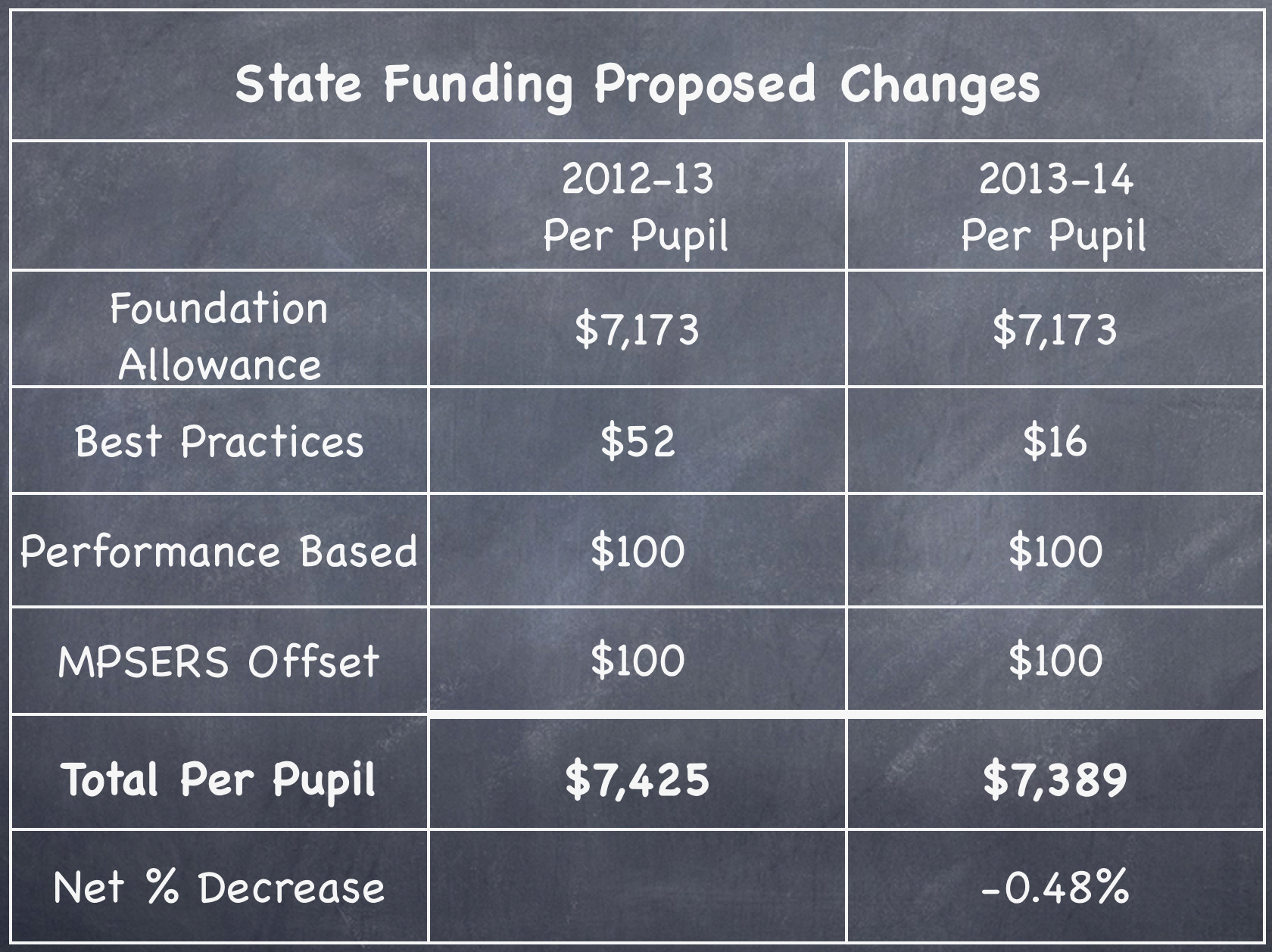
Here are some of the other details related to Gov. Synder’s proposal:
2013-14 School Aid Budget Proposal
Governor Snyder released his 2013-14 budget last week, and while overall funding appears to be up by more than 2.2%, funding for Saline is a distinctly different story.
The governor’s proposed budget for fiscal year 2014 recommends total funding of $13.3 billion. The budget calls for increased funding for early childhood programs, retirement and equity payments. Highlights of the proposed budget include:
Early Childhood Programming – The Executive Recommendation an additional $65 million investment in the Great Start preschool program for FY 14 and FY 15. The investment would increase half day payments to preschool providers by $225 per child. The new half day rate would increase to $3,625 per child. This could help Pooh Corner. Contact them directly to learn more about Great Start options.
Retirement – The budget reflects the state’s statutory requirement to pay increased retirement costs for unfunded accrued liabilities beyond the 2012 capped amount. As a result, the state will pick an additional $408 million in increased retirement costs. However, that also reflects the inclusion of $155 million in MPSERS reimbursements to districts included last year. Normal pension costs will increase slightly (less than .5 percent) for districts. This is good news for the longer term, but does not help in the short term.
Best Practice Requirements – $25 million in funding or $16 per pupil for districts that meet best practices requirements. This number represents a decrease of $55 million or $36 per pupil less available for districts. Saline Area Schools captured the full $52 per pupil this year. Next year it will likely be $16 per pupil.
District Performance Grants – Continues $30 million to reward districts that achieve performance standards (up to $100 per pupil). This is unchanged from last year, however, we do not yet know the qualifications for the performance funding.
Technology Infrastructure Grants – The Executive recommends funding the second year of technology infrastructure grants programs at $13.5 million for FY 14. Technology grants are currently funded at $50m. The Executive recommendation removes computer adaptive test usage and adds instructional practice and shared service consolidation of technology, and data including both hardware and software in preparation for the planned implementation of online growth assessments. Saline Area Schools did capture some funding here last year and hope to get some again in 2013/2014.
Equity Payment – Inclusion of an equity payment of up to $34 per pupil for districts at or near the minimum foundation allowance, increasing the minimum per-pupil amount to $7,000. Saline is not eligible.
Small class size supplemental payments -. Districts that receive small class size supplemental payments and have a per-pupil foundation allowance less than $7,500 will receive no more than $100 per pupil, and districts that receive small class size payments and have a per-pupil foundation allowance greater than $7,500 will receive no more than $50 per pupil. A total of $9 million will be paid out in small class size payments. Former 32e districts eligible, requiring 50% free/reduced lunch counts. Saline is not eligible.
The two items below are interesting and possible options for Saline Area Schools to pursue. However, at this point we do not have details.
“New” Digital Learning initiative – Funded with $10 million, to encourage online learning opportunities for students.
“New” competitive Student Centric Learning Grants – $8 million will be used to reward districts that have aligned instructional delivery with individual student learning styles and pace.
Best Fit Grouping
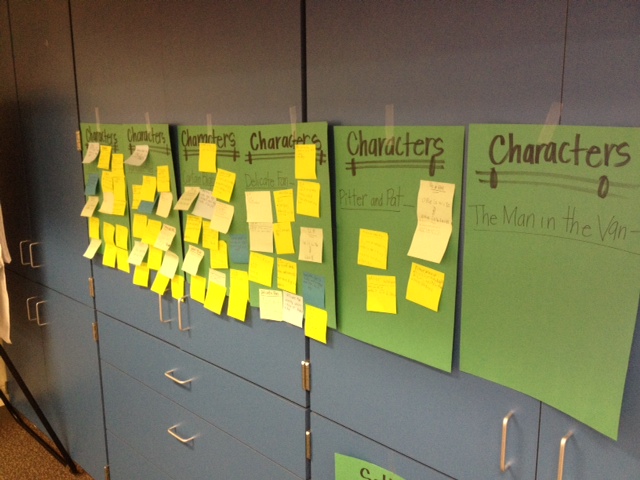
Activity for students to detail information about characters from a story.
Last week I had the opportunity to watch our 2nd grade students and staff during “Best Fit” time at Pleasant Ridge. During this time all 2nd graders are “regrouped” based on reading levels. They are then given specific instruction to help them improve. It’s an “all hands on deck” model with classroom teachers, special education teachers and reading tutors all taking groups of students. This allows for small group instruction on important literacy strategies. Needless to say, this takes a great deal of coordination, flexibility and collaboration on the part of the staff. We are doing “Best Fit” groups for literacy at all of our elementary buildings this year.
After watching it in action on Thursday, I came away extremely impressed by the impact this is having on our students and on the level of collaboration between the staff. It was a team approach with the students’ needs at the center of the conversation.
The process reminded me of the quote from Charles Darwin,
In the long history of humankind it is those who learned to collaborate and improvise most effectively that have prevailed.
Profiles In Courage
I’ve had the opportunity over the last several weeks to read Profiles In Courage by John F. Kennedy. In the book he profiles eight U.S. Senators who made courageous decisions. Each ones was faced with and made a difficult decision that at the time was unpopular. In each case they suffered politically for the decision they made and in some cases they suffered deep personal loss. History has shown they were on the right side of the issues they struggled with… but at the time they were vilified.
As I look at current situations in Washington D.C. and Lansing I wonder if the type of courage displayed in the book is absent, or will history be the judge.
John F. Kennedy wrote,
A nation which has forgotten the quality of courage which in the past has been brought to public life is not as likely to insist upon or reward the quality in its chosen leaders today – and in fact we have forgotten.
The book was a Pulitzer Prize winner in 1957. It’s worth the time if you haven’t read it yet, especially if you like U.S. History.
The Importance of Being “Learning Agile”
I recently read a white paper titled, “Learning About Learning Agility” by Adam Mitchison and Robert Morris, Ph.D. The paper talks about leadership skills and the learning traits necessary to succeed in the current world of rapid change. They describe the collection of traits and skills being “learning agile”.
Learning-agile individuals practice disciplined personal development in five ways:
- Innovating: They are not afraid to challenge the status quo
- Performing: They remain calm in the face of difficulty
- Reflecting: They take time to reflect on their experiences
- Risking: They purposefully put themselves in challenging situations
- Defending: They are simply open to learning and resist the temptation to become defensive in the face of adversity
Of these five facets of learning agility, leaders consistently report risk-taking to be the hardest to enact within their organizations. Learning-agile individuals tend to be more social, creative, focused and resilient. They are less interested in accommodating others and are not afraid to challenge norms. Learning-agile behaviors matter to others; managers seem to value those who are less defensive and who are open to feedback; peers and direct reports appear to value those who are more reflective and willing to change.
The paper is an excellent reminder of the skills we need as adults. The concepts detailed in the paper should also help guide us as we develop our learning objectives for our students. As the Saline Area Schools Mission Statement says, “Our ultimate goal is to instill in our students a desire for lifelong learning.” This statement has never been more true.
Visit to Adlai Stevenson High School
Earlier this week, along with 11 other Saline Area School staff, I had the opportunity to visit and learn about the innovative programs that are a part of Adlai Stevenson High School in Lincolnshire, Illinois. The visit was a great reminder that learning from peers can be very powerful. It was also a reminder that while we will must always be working to improve, we do a lot of things very well in Saline.
One of the things that they recently did at Stevenson High School is move away from letter grades in fine arts courses. Choosing instead to develop a 1-4 rubric to assess skill relative to the course objectives. Students can still choose to have their rubric score converted to a grade for their GPA, but it is not mandatory.
It is an interesting approach to move the conversation toward learning/skill development and away from grading practices.
Safety & Security Update
The recent shootings at an elementary school in Newtown, CT have reminded us that we need remain focused on how best to protect children in our schools. All children have the right to go to school and learn in a safe and nurturing environment. Educational research shows that learning is enhanced when children feel safe in a healthy school environment.
As a school and community we need to work together to keep our students safe. Over the last two months we have reviewed and reinforced our policies related to our safety protocols – with an emphasis on entry and egress areas. We are continuing to evaluate our facilities and crisis plans to determine appropriate next steps.
Here is a list of some of the areas of discussion:
- Increased patrols & visits by law enforcement
- Renewed emphasis on visitor policies (We ask for patience and consideration with staff if you are visiting as we ask all visitors to follow procedures)
- Modification of entry / egress where applicable
- Identification of special circumstances / events where gaps may exist
- Building modification relative to entry / egress
- Additional use of cameras in all school buildings
- Key card access to all doors district-wide
In addition, we have been reviewing and assessing our access to resources that can help with school safety and security. They include:
- School Resources
- Guidance counselors & social workers
- Teachers / administrators
- Communication Plans
- Community Resources
- Psychologists, psychiatrists & social workers
- Law enforcement
Overall, we need to remain focused on what we want our school facilities to look and feel like for our students and staff. Our plan is to be thoughtful and deliberate in our review of potential strategies and to implement only those changes that will provide a sustained benefit to our students, staff and community.
Seven Keys to College Readiness
Montgomery County Public Schools is widely considered one of the highest performing school districts in the country. In 2009, they produced their “Seven Keys to College Readiness” that provided important guidance for families from kindergarten through high school. With the Common Core and other adjustments to curriculum coming nest year, they are in the process of redefining the keys.
Recently, Montgomery Superintendent Joshua Starr indicated they need broaden the system’s definition of student success to include skills not measured in standardized tests — such as persistence, motivation and grit — in addition to traditional academic learning focused on reading and math.
I am very interested to see how their new keys develop. Montgomery County Public Schools has 149,000 students and over 11,000 teachers. They have the resources and internal research capacity that most of us can only dream about, however, we are also working to redefine student success with the revisions to Goals #1 & #2 of our Strategic Framework.
In a few months, we will be able to compare notes….
Focus on execution…
It’s pretty easy to come up with great ideas. It’s also fairly easy to develop solid plans. The key is execution… can you execute your plan? Can you take a great idea and implement it well? Executing is an art and a science – especially in an educational setting where the goal is to benefit students, families, staff and communities. A great idea or program that is poorly implemented is no better than a poor idea/program.
It’s important that once we know what we want to do, we take the time to think about how best to implement. This is a concept I want to keep in the forefront as we go through the Strategic Framework revision. I have no doubt that the community members and staff helping this process will take great ideas and develop strong plans – the key is for us as a school community to implement the plans in a manner that benefits our students and community.
I was recently given a quote from John Stumpf, the CEO of Wells Fargo by a community member about the importance of executing.
“We always say we could leave our strategic plan on an airplane, somebody could pick it up, and it wouldn’t matter. It’s all about execution. It’s how you hire, how you inspire, your culture, how you reward, how you celebrate victories, how you deal with disappointments. This is easy to talk about, but it is all in the execution.
Let’s not get passed by….
One of the nice things about January (other than a 60 degree day!) is the chance to think about the new year and the future. As a community and district we are currently reviewing and updating our Strategic Framework with the help of 50+ community members and staff. As this process unfolds, I am reminded of the quote from Clayton Christensen who authored the book Disrupting Class in 2008. The book discusses the issues facing schools in an era when information is available to everyone – a very good book for anyone interested education.
“If you only do what worked in the past, you will wake up one day and find that you’ve been passed by.” – Clayton Christensen
Happy New Year & Welcome Back to School!
School is back in session tomorrow – Monday, January 7th. We hope to see all of our students rested, healthy, and ready for the second half of the school year. Remember to follow @SalineSchools on Twitter, the Saline Area Schools Facebook page or tune into local radio or T.V. stations to get the latest update on weather resulting in possible school closures. For our elementary families, make sure kids come dressed for cold outdoor recesses.


 Scot Graden's Blog