Why you will fail to have a great career
Very interesting TED Talk from Larry Smith….. there are excuses everywhere… We need to find ways to keep our students dreaming.
Responding to an Emergency
Things you CAN do:
Food can be donated either at Mill Creek or the LaFontaine dealership. Things like milk, juice, fresh fruit, and coffee can be used, as well as snack foods, etc. Many might not have anything but the clothes on their backs! Often insurance $ won’t kick in for a bit but they need just basics for a little while (clothes, shoes, back packs, etc., think of the things you use every day)
The Red Cross website says $ is needed, help get that message out: from their website www.wc-redcross.org“If you would like to make a donation, please call 734-971-5300 or click here to make a secure online donation. We also welcome you to make a donation in person at the American Red Cross, Washtenaw-Lenawee Chapter, 4624 Packard Road, Ann Arbor, Michigan, 48108.”
Working for the future…
I have been reading and viewing other medias about the state of public education over the last several months. It is not a pretty picture, however, there is a reality that does not seem to be discussed. As educators we want to improve our schools. In Saline, we are focused on building a strong foundation by implementing new research findings related to literacy. We are investigating how mobile technology and blended learning can revolutionize students’ school experience. We are building partnerships with businesses, foundations, and higher education. In the face of cutbacks and limited resources we are focused on making Saline Area Schools a place where our staff love to work and our students love to learn.
As we pursue these goals one thing is clear – we can’t do it alone. We need the support of the community. We know that strengthening the relationship between our community and our school will result in increased student success. As we begin the last third of the school year, I strongly encourage you to get involved or stay involved. Working together we can help each student reach their full potential.
State Champs!
Congratulations to Coach Todd Brunty and the entire Saline Boys Swim & Dive program. They have become the first program in school history to win three consecutive state championships. The success they have achieved is truly remarkable!
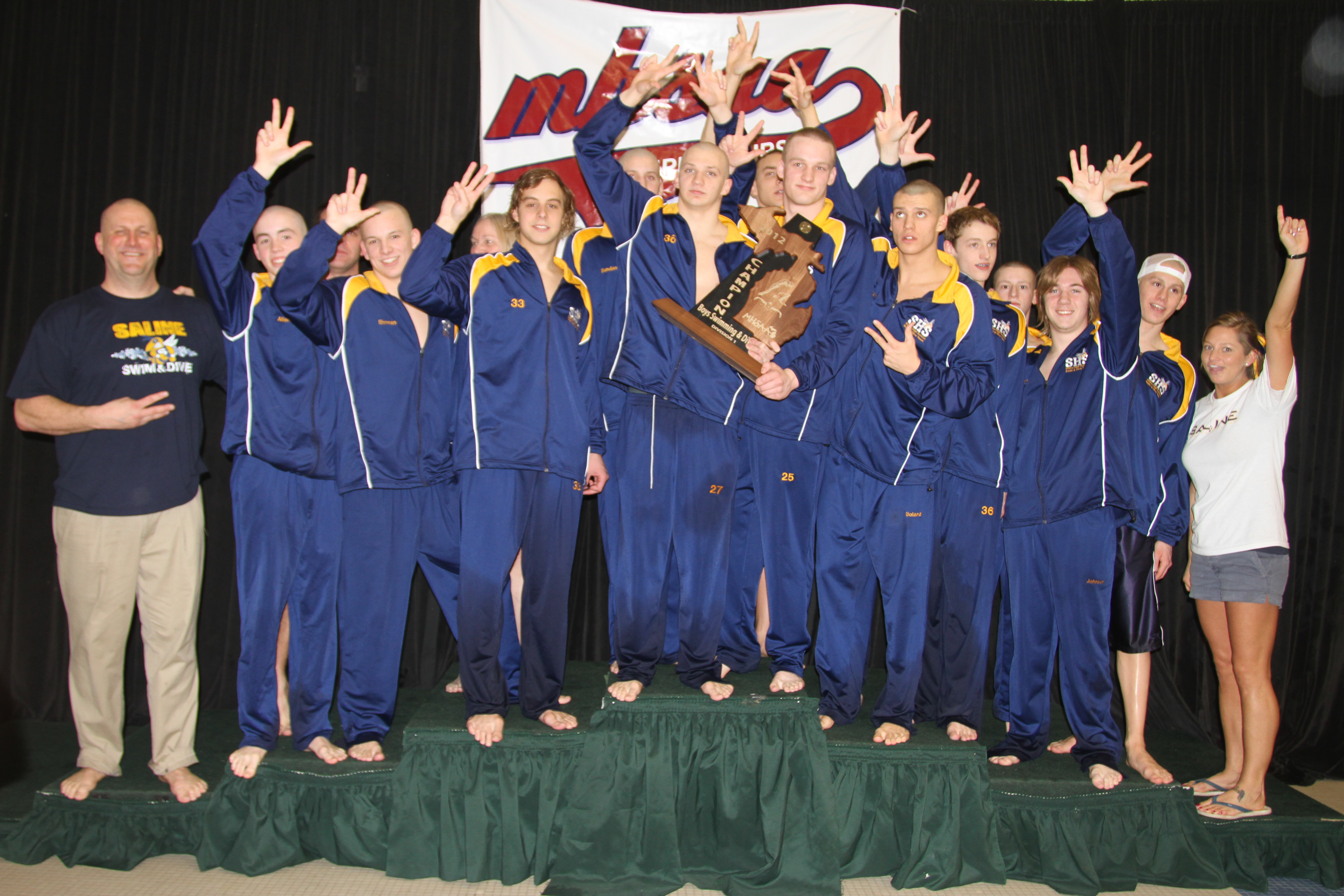
2012 Boys Swim & Dive Division I State Champions Photo Credit: Tran Longmoore
For more information about their success – Saline Patch, Ann Arbor.com and Saline Reporter
Creativity…
In a recent article in The Chronicle Review, it was noted that certain qualities will be key to U.S. success in the decades ahead: cognitive flexibility, design thinking, and non-routine approaches to messy problems. “Simply put, America cannot maintain a competitive position in the world unless we better understand how to nurture creative talent and put in place policies and practices to do so.”
The authors noted, to prepare students for the global economy, we first need to get past “the naively egalitarian, almost mystical view of creativity advanced by many creativity enthusiasts” – that it will naturally flow if we structure the right conditions. “Existing research suggests otherwise,” they say. “Creativity is not a mysterious quality, nor can one simply try one of Edward de Bono’s six thinking hats to start the creative juices flowing. Research indicates creativity is cultivated through rigorous training and by deliberately practicing certain core abilities and skills over an extended period of time” This training includes:
- Using analogy and metaphor to approach problems in non-routine ways;
- Being able to use critical feedback to revise and improve an idea;
- Posing “what if” propositions and reframing problems;
- Looking closely for new and unexpected patterns;
- Being willing to risk failure in the face of ambiguity and uncertainty;
- Being able to bring people, power, and resources together to implement an idea;
- Being able to draw on visual, oral, written, and media tools to communicate ideas.
One of the best places to find this kind of training is in the arts. As we continue to refine standards and prepare for the Common Core, the arts must remain a critical component in a well rounded curriculum.
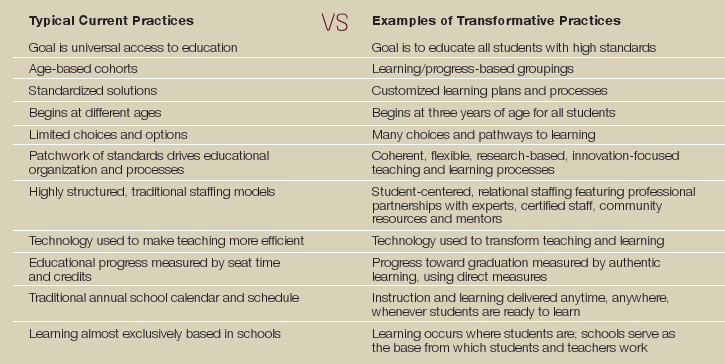
The Connecticut Association of Public School Superintendents has taken an interesting position on the issue of transformative practices.
With a new model that places the “learner” at the center of all strategy and action, CAPSS has developed a set of action-oriented recommendations that will address the complex problems we face today, transform learning and ensure that Connecticut’s children receive the best possible education.
I wonder if the Michigan Association of School Administrators will take a bold stand like this…?
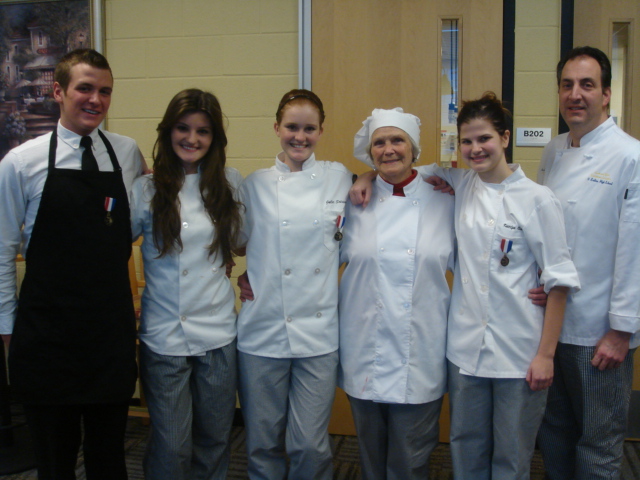
Regional SkillsUSA Medal Winners
Self Awareness
I have been thinking recently about the concept of “good judgement” and what it means to exercise good judgement as a leader. In many ways, judgement is at the core of leadership. Harvard professor Bill George states,
“Becoming an authentic leader is not easy. First you have to understand yourself, because the hardest person you will ever have to lead is yourself. Once you have an understanding of your authentic self, you will find that leading others is much easier.”
For myself, learning to use good judgement has meant a great deal of self reflection. It has meant dealing with the fear of making a bad decision. One tool I have used to assess my own ability to understand how I manage decisions is from a book by University of Michigan professor Noel Tichy and University of Southern California professor Warren Bennis.
Exercising Courage in Judgment
1. Fear of Action – inaction even when the need to act is known; preference for the status quo over change
2. Fear of Criticism – concern that a key stakeholder will be critical of a judgement or the required execution
3. Fear of Defiance – worry that others will not follow your leadership judgment, thereby undermining your leadership authority
4. Fear of Personal Loss – concern that something of value or career opportunity may be lost taking the necessary action
5. Fear of Insufficient or Imperfect Information – self-doubt and concern that in the absence of perfect information, your conclusions are wrong
By rating these areas on a scale of 1 to 5 you may get a sense of the extent to which you think each area impacts your judgement. It’s an important step in understanding your own decision making process.
All Day Kindergarten – Financial Viewpoint
The Michigan Legislature approved rules last year regarding the funding of kindergarten programs. Starting in September 2012, schools must provide full day kindergarten in order to receive full funding. With the shift from collecting a full per student allowance for half day kindergarten to receiving a full per student allowance only for full day programs, many districts, including Saline, are now planning to offer full day kindergarten. I don’t want to get into the academic or social-emotional merits of full day vs. half day or my opinion on the historic rationale for the funding model, however, I do want to explain the financial implications of the decision.
In the Fall of 2011, we had 330 kindergarten students enrolled. With a per student allowance from the State of $7,173, we collected approximately $2.37 million in revenue to educate our kindergarten students. In addition, because of our half day structure, we collect just under $300,000 in revenue from families that choose our Extended Day Option program – bringing our revenue for kindergarten to $2.67 million.
If we keep the same format of half day kindergarten for next year, and collect 50% of the foundational allowance ( or roughly $3,586 per student), we would collect a $1.18 million and $300,000 in Extended Day Option revenue for a total revenue of $1.48 million in revenue.
Moving to full day kindergarten allows us to capture the full $2.37 million in State revenue, however, we do lose the $300,000 in Extended Day Option revenue, therefore our net revenue would remain $2.37 million. The full day decision nets the district $890,000 more in revenue than staying with the half day model. There are additional expenses associated with going to full day. We will need to add staff, equip additional classrooms, etc. and we estimate that cost to be in the $200,000 range. Those expenses will be offset somewhat by not having mid-day busing.
Overall, the shift in kindergarten funding by the State will cost the district more in 2012-2013 than in 2011-2012 – that is unavoidable. However, based on the new funding model the reality is that moving to all day kindergarten makes the most sense for Saline Area Schools from a financial perspective.
Human Capital
Saline Area Schools is a organization that reveals its strength in providing services from the collective skills of our staff. This is often referred to as human capital. Research indicates that the best uses of our “human capital” requires a clear understanding of our district goals and how the skills of our staff fit the pursuit of these goals. It’s important for our success to align these skills to focus on our long term goals.
In order to maximize our efforts, I have a goal to build a system that is leader-proof. I want the entire community to feel the work we are doing is so great that they want it to continue no matter who is in the superintendent’s chair. This type of system is built on teamwork that makes us care more about the overall success of the team and district than about individual success. As an individual, it’s about being present, giving 100% of ourselves, and understanding we need to model continuous learning.
In the end, for us to maximize the opportunity for success – team work and hard work are the keys.


 Scot Graden's Blog